How to play with your cat: a 9-minute Hunt
The best way to play with a cat is to run a short hunt: a toy that moves like prey, a real catch, one more chase, and then a meal.
That's the whole idea. It takes about nine minutes, you need one wand toy and a small meal or treat, and you can do it tonight. This guide walks you through it stage by stage, then covers what to do when your cat just stares at you.
Why cat play is a hunt, not fetch
Your cat is a small hunter, even if the only thing they've ever caught is a hair tie. A cat's hunt follows the same order every time. They watch, they creep closer, they pounce, they hold on, and then they eat. Play feels good to a cat when it follows that order and ends where a real hunt ends.
That's why fetch doesn't fit. Fetch is a dog game built around bringing something back to you. A cat's game is built around catching something that is running away. Some cats do learn to fetch, but you don't need it, and a cat who ignores a thrown ball isn't broken. They're waiting for something worth chasing. (More on what makes cats tick in why cats knock things over and get the zoomies.)
It also isn't "exercise" in the treadmill sense. The goal isn't to tire your cat out by making them run in circles. The goal is a hunt that feels real enough to finish, so your cat ends the session relaxed and satisfied instead of wound up.
The 9-minute Hunt, in four stages
Here is the full session. The times are a guide, not a rule. Watch your cat, not the clock.
1. Stalk and chase (about 4 minutes)
Grab a wand toy, the kind with a feather or a fabric mouse on a string. Start a few steps away from your cat and make the toy act like a small, nervous animal.
Move it away from your cat, never toward their face. Real prey runs away from a hunter. Drag it slowly along the floor, let it disappear behind a chair leg or under a blanket, and then stop. Those pauses matter. A still toy that might move again is what makes a cat crouch, wiggle their back end and get ready to pounce.
Mix slow creeping with a few quick dashes. If your cat chases, let the toy run. If they freeze and watch, that's still hunting, so keep going.
2. Catch (about 1 minute)
Now let your cat win. When they grab the toy, don't pull it away. Hold the wand still and let them bite it, wrap their front legs around it and kick it with their back legs. Give them a good 30 to 60 seconds with it.
This is the part most people skip, and it's usually why a cat stops playing. A toy that always gets away is a tease, not a game. Cats need to catch something to feel the hunt worked.
3. Round two (about 3 minutes)
When your cat lets go, the "prey" escapes. Start a second chase, ideally with a different toy if you have one. Change direction and speed so it feels new: low and slow along a wall, then a sudden dart across the room.
Round two is shorter and a little calmer than the first. It still ends with a catch, so your cat never finishes on a miss.
4. Final catch and meal (about 1 minute)
Slow the toy right down so it's easy to catch, and let your cat make one last clean grab. Then put the toy away and serve a small meal or a meaty treat straight away.
The catch closes the hunt, and the food closes the cycle. Hunt, eat, then settle. Many cats will groom and nap after this, which is exactly what you want. A good time to fit the Hunt in is just before a meal you were going to give anyway.
Wand, laser or phone game: which one to use
All three get called "cat toys," but they do different jobs.
| Tool | What it's good for | Watch out for |
|---|---|---|
| Wand toy (feather or toy on a string) | A full Hunt with you, from stalk to catch | Put it away after play so your cat can't chew or swallow the string |
| Laser pointer | Chasing only | There's nothing to catch, so always finish on a physical toy and a meal |
| Phone or tablet "cat game" | Your cat watching a screen | It's the wrong job for play together. Your cat can't catch anything, and you aren't part of it |
If you only have a laser, use it for the chase in stage one, then switch to something your cat can actually grab for the catch. A crumpled ball of paper or a small plush toy works.
"My cat won't play with me"
This is the most common worry for new cat owners, and it's usually fixable. Work through these one at a time.
The toy is coming at them. Waving a toy in a cat's face feels like a threat, not a snack. Move it away and to the side.
They never get to catch it. If every session is chasing with no catch, your cat learns it's pointless. Let them win early and often.
The timing is off. Many cats are most playful around dawn and in the evening. Try just before dinner instead of right after it.
The session is too long. Nine minutes is plenty. Going on until your cat walks away teaches them that play ends in boredom.
You're using your hands. Fingers and toes as toys teach a cat that hands are prey. Keep a toy between you and your cat every time.
It's laser only. Chasing a dot with no catch can leave a cat frustrated. End on something they can hold.
The toy is the same every day. A new feather, a crinkly toy or a toy hidden under a towel can turn a bored cat into a hunter again.
Read your cat while you play
You can tell how the hunt is going by watching your cat's body.
Ears forward, tail tip twitching and big round pupils mean your cat is in it. Keep going.
Ears pulled back, tail thumping and a body pressed flat to the floor mean it's getting too intense. Slow the toy down, give them a catch, and ease off.
And if your cat stops and just stares at the toy, they probably haven't quit. Staring is often the start of the next stalk. Give them a few seconds before you decide they're done.
If your cat suddenly stops playing altogether and also seems different in other ways, check in with your vet. This guide is about play, not health.
How often to run a Hunt
Once or twice a day is a great rhythm for most indoor cats, at the times your cat already has the most energy. A short Hunt every day does more than one long session on the weekend.
The routine is part of the fun. Cats like knowing when the good stuff happens, and many will start showing up at Hunt time on their own.
Run tonight's Hunt with a coach in your pocket
Everything above works with a wand toy and a bowl of food. If you'd like someone to keep time and tell you what to do next, the PetCool app runs this exact Hunt with you.
Today's Hunt walks you through all four stages, Stalk and chase, Catch, Round 2 and Final catch plus meal, with a short coaching tip on screen for each one. It also reminds you what an engaged cat looks like and when to ease off.
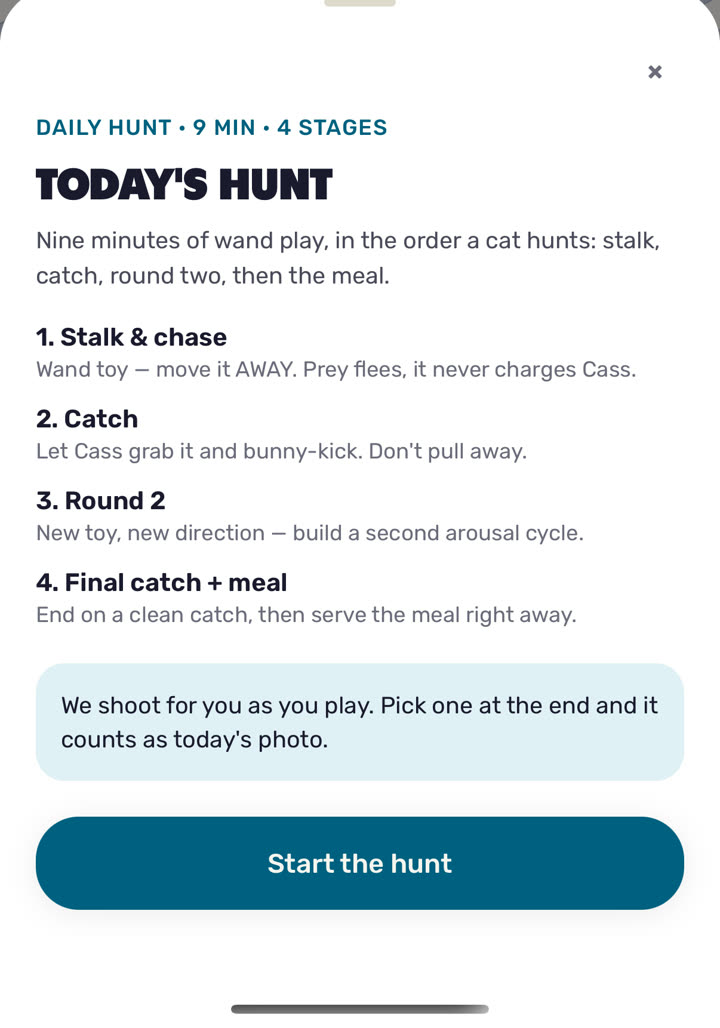
While you play, the app takes photos of your cat for you. At the end you pick your favorite, and it counts as your cat's photo for the day, so a Hunt also keeps your daily photo streak going.
Finish every stage and your cat earns coins, XP and a stat boost, and climbs their bond ladder from Comfort all the way to Master. A Hunt only pays out when you play it through, so there's no rushing it. And because a Hunt is a cat game, PetCool never asks your cat to fetch. If you have a dog too, they get their own tricks in the app.
PetCool is free to download, and PetCool Pro adds more when you want it. You can get it at petcool.app and run your first Hunt tonight.
FAQ
Does a Hunt count toward a streak?
Yes. The photo you pick at the end of a Hunt counts as your cat's photo for the day, which keeps your daily photo streak going.
How should I play with my cat?
Treat play as a short hunt. Use a wand toy and move it away from your cat with pauses and hiding spots, let them stalk and catch it, run a shorter second round, then end with a slow final catch and a small meal or treat. About nine minutes is enough. Don't use your hands as toys, and don't end on a laser with nothing to catch.
How long should I play with my cat each day?
About nine to ten minutes per session, once or twice a day, is plenty for most cats. Short and regular beats long and rare.
Why won't my indoor cat play with me?
The usual reasons are a toy that moves toward their face, a toy they're never allowed to catch, the wrong time of day, or sessions that go on too long. Move the toy away from your cat, let them win, try dawn or evening, and keep it short. If they freeze and stare, wait a moment, because that's often the start of another stalk.
Is a laser pointer bad for cats?
A laser is fine for chasing, but there's nothing to catch at the end, which can leave a cat frustrated. If you use one, always finish with a toy your cat can grab and then a meal.
Should I feed my cat after playing?
Yes. In a real hunt, the catch is followed by eating. Serving a small meal or a meaty treat right after the final catch tells your cat the hunt is over and helps them settle.
Why don't cats play fetch?
Fetch is about bringing something back to you, which is a dog's game. A cat's game is about catching something that runs away. Some cats do fetch, but it isn't something a cat needs, and a cat who ignores a ball isn't a cat who won't play.
Can an app coach me through playing with my cat?
Yes. PetCool's daily Hunt walks you through stalk, catch, round two and the meal with a coaching tip for each stage, and takes photos of your cat while you play. It's free to download.